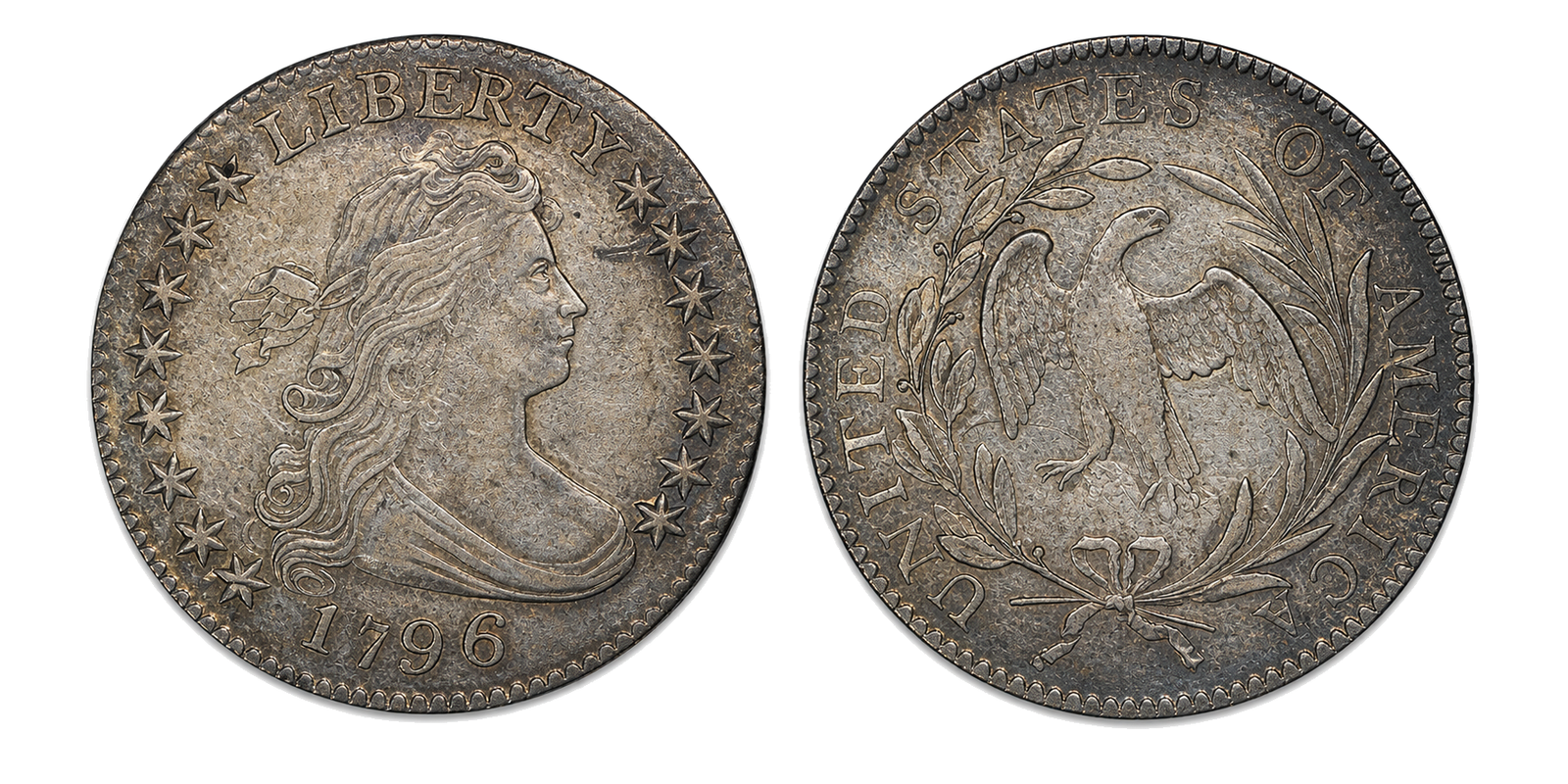
The first United States dimes
Regular dime production began at the Philadelphia Mint in 1796, four years after Congress authorized the denomination. Robert Scot adapted the Draped Bust portrait to this small silver format and paired it with the young eagle reverse then used on several federal denominations.
The Small Eagle dime lasted only through 1797. When dime coinage resumed in 1798, a heraldic eagle based on the Great Seal replaced it, leaving the 1796–1797 pieces as a two-year type. Mint records report 22,135 dimes for 1796 and 25,261 for 1797.
Star arrangements and die marriages
Seven JR die marriages are recognized for 1796. The 1797 coinage begins with an obvious split between thirteen-star and sixteen-star obverses, after which the individual die pairing can be identified. The absence of a denomination inscription is characteristic of this first dime design.